
Do you need a permit to remove a tree in Georgia?
Usually not, if the tree stands on a lot with your home on it. Georgia law lets each city and county write its own tree ordinance. Most of those ordinances leave homeowners free to remove trees on their own property. A tree removal permit shows up on vacant land, development sites, large protected trees and public property.
Each rule below belongs to the city or county named with it. Check with that office before you set a cut date. Our part is taking the tree down with a chainsaw and an excavator.
Who writes the tree rules in Georgia?
Cities and counties do. Under O.C.G.A. 12-6-24, Georgia law lets county and city governments enact and enforce tree ordinances. That is why the answer can change at a city line.
In 2005, a Georgia Senate study committee looked at those ordinances. It found the vast majority let homeowners freely remove trees on their own property. A sample of 180 local ordinances turned up 19 that did not completely exempt homeowners from tree removal permits. That count is from 2005, so check your own city before cutting.
Where a permit does reach a developed home lot, it usually covers only some of the trees. The Georgia Tree Council says it often covers one category, such as specimen trees. Some permits apply only above a minimum trunk size. Others kick in past a set number of removals in a period of time.
Tree size is measured as DBH, the diameter at breast height. Savannah’s ordinance measures it 4.5 feet above the natural grade at the base of the tree. Savannah and Richmond Hill both set their size limits in inches of DBH.
Do you need a permit to remove a tree in Statesboro?
Not on a single-family property, going by the city’s Department of Engineering. Its page says the tree ordinance covers anyone developing or clearing trees on property other than a single-family property. The ordinance’s name is the Urban Forest Beautification and Conservation Ordinance. Those developments must provide the required greenspace and tree canopy.
New houses carry one more rule. The Statesboro Herald reported it from the city’s 2023 Unified Development Code. Every new single-family house lot must keep at least one medium or large tree at all times. The code defines those sizes, so ask the city before the last big one comes down.
What about rural Bulloch County?
Outside Statesboro, unincorporated Bulloch County follows its own zoning ordinance, dated April 4, 2023 on the county site. Its river corridor article names the Ogeechee River a protected river in the county. A 100-foot natural vegetative buffer has to be kept along it. The buffer covers the ground within 100 feet of either bank.
Timber harvesting is allowed inside that corridor. It has to follow the Georgia Forestry Commission’s best management practices and leave the river’s drinking water quality intact. For a tree anywhere else in the unincorporated county, call the county’s planning and development office before you cut. Our guide to land clearing permits around Statesboro covers the land disturbance rules for bigger jobs.
What are Savannah’s tree rules?
An early ordinance of the 1733 colony read “No tree may be cut without the express permission of Noble Jones.” Today the rules sit in the city’s Landscape and Tree Protection Ordinance. The text on the city’s website dates from 2017.
That ordinance exempts residential lots with an existing single-family home or duplex from its tree permit requirements. The exemption lasts until the lot is converted to non-residential or multifamily use. On a lot like that, the city’s tree permit rules do not apply.
Other property is a different case. On developed property other than single-family lots, every tree 12 inches DBH or larger is protected. On undeveloped property, any tree greater than two inches DBH is protected. Removing a protected tree there takes a clearing permit first.
Public trees follow their own rule, even in front of a house. Pruning or removing a tree on public property, like the city right of way, takes the city’s written approval. Savannah lists its Tree Ordinance Administration under the Park and Tree Department, so start there. We take on tree removal across Savannah and Chatham County.
What about unincorporated Chatham County?
Outside the cities, Chatham County’s Land-Disturbing Activities Ordinance covers all land in the unincorporated area. Under it, a property owner may not clear property without first getting a Land-Disturbing Activity permit. The ordinance defines clearing as the removal of vegetation, not counting grubbing.
Two exemptions matter for homes and farms. All single-family lots recorded before the ordinance was enacted are exempt. So is land zoned for agricultural purposes, for as long as it stays in that use. The same ordinance aims to keep at least fifty percent canopy cover across the unincorporated county, wherever possible.
The county engineer administers the ordinance. That title belongs to the director of the Chatham County Engineering Department, so questions go to that office.
Do Richmond Hill and Pooler require tree removal permits?
Richmond Hill does for its two classes of protected trees. Heritage trees run from 16 up to 28 inches DBH. Historic trees are any tree 28 inches DBH or greater. Approval to remove either kind comes from the city’s planning director.
Removed protected trees have to be replaced under the city’s Unified Development Ordinance, Article 15, Section 15.6. An approval is good for 60 days. Anyone who fails to get a tree removal permit gets cited. We also cover tree work in Richmond Hill and the rest of Bryan County.
Pooler issues tree removal permits under its Code of Ordinances, Chapter 42, Article VI, Tree Protection. The 2024 application asks for each tree’s location, size and species, plus proposed replacement trees. The form comes from the city’s Planning and Development Department. Ask there whether your lot needs one before tree work in Pooler gets scheduled.
Do you need a permit to cut timber in Georgia?
Not a local one, on land zoned for farming or forestry. O.C.G.A. 12-6-24 bars cities and counties from requiring a permit for timber harvesting on that land. They may require a notice, and they may not charge a fee for it. The notice can be due before cutting starts, or at the latest within 24 hours of starting.
That limit covers harvests that are forestry or farm operations, not incidental to development. A harvest that is part of building on the land falls outside it. In Bulloch County, a harvest along the Ogeechee also has to follow the river corridor rule.
Which places need a tree removal permit?
This table sums up each place for a lot that already has a house on it. The office in the last column has the final word.
| Place | Existing home lot needs a permit? | What the rule covers | Office to ask |
|---|---|---|---|
| Statesboro city limits | No, per the city engineering page; the tree ordinance covers other property | Trees on property being developed or cleared; one medium or large tree on each new house lot | City Department of Engineering |
| Unincorporated Bulloch County | Ask the county | A 100 foot natural vegetative buffer along the Ogeechee River | County planning and development office |
| Savannah | No, while it holds a single family home or duplex | 12 inches DBH and up on other developed property; over 2 inches DBH on undeveloped land; trees on public property | Park and Tree Department |
| Unincorporated Chatham County | No, if the lot was recorded before the ordinance | Clearing vegetation takes a Land Disturbing Activity permit | County Engineering Department |
| Richmond Hill | Ask the planning director | Heritage trees 16 to 28 inches DBH; Historic trees 28 inches DBH and up | Planning director |
| Pooler | Ask the city | Trees under Chapter 42, Article VI, Tree Protection | Planning and Development Department |
| Farm or forestry land | No local permit for a timber harvest | A notice may be required, with no fee | Your city or county |
What about the stump and the brush?
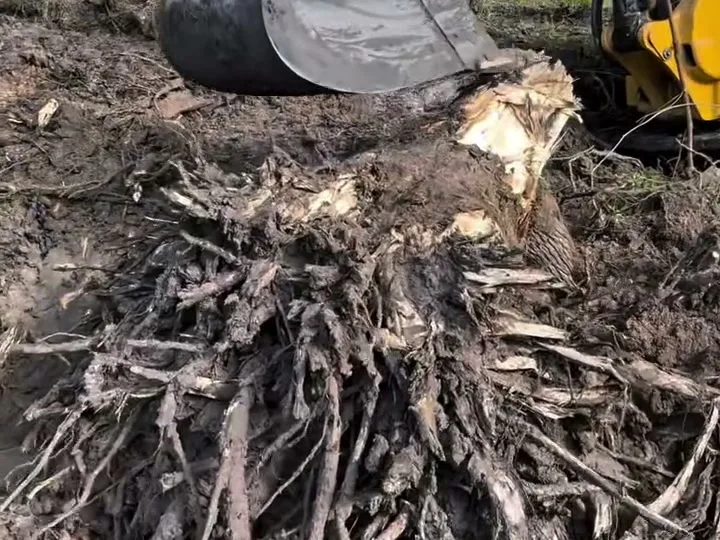
A stump that comes out whole means digging. Georgia 811 must be contacted before anyone digs, and pulling a stump with an excavator is digging. We take stumps out whole, roots and all, with the CAT 308 excavator.
The Georgia Forestry Commission requires notification or a burn permit for land clearing burns and vegetative storm debris, at 1-800-GA-TREES. Hand piled leaves and limbs follow a different rule. Our page on Georgia burn and land disturbance permits covers both. Hauling skips the burn: logs and brush leave on our dump trailer.
For prices, our Georgia tree removal cost guide collects published ranges from national cost guides. Your tree gets its own number at the free estimate.
How does a tree job get started?
Estimates are free, and they start with a look at the tree in person. We check its height and how close it stands to the house. Then we tell you how the excavator gets to it and where the tree can fall.
If your property sits in one of the places in this guide, settle the permit question with that office first. Then call or text (912) 712-6034 for a free estimate. See how our tree removal works from the first cut to the cleanup.