
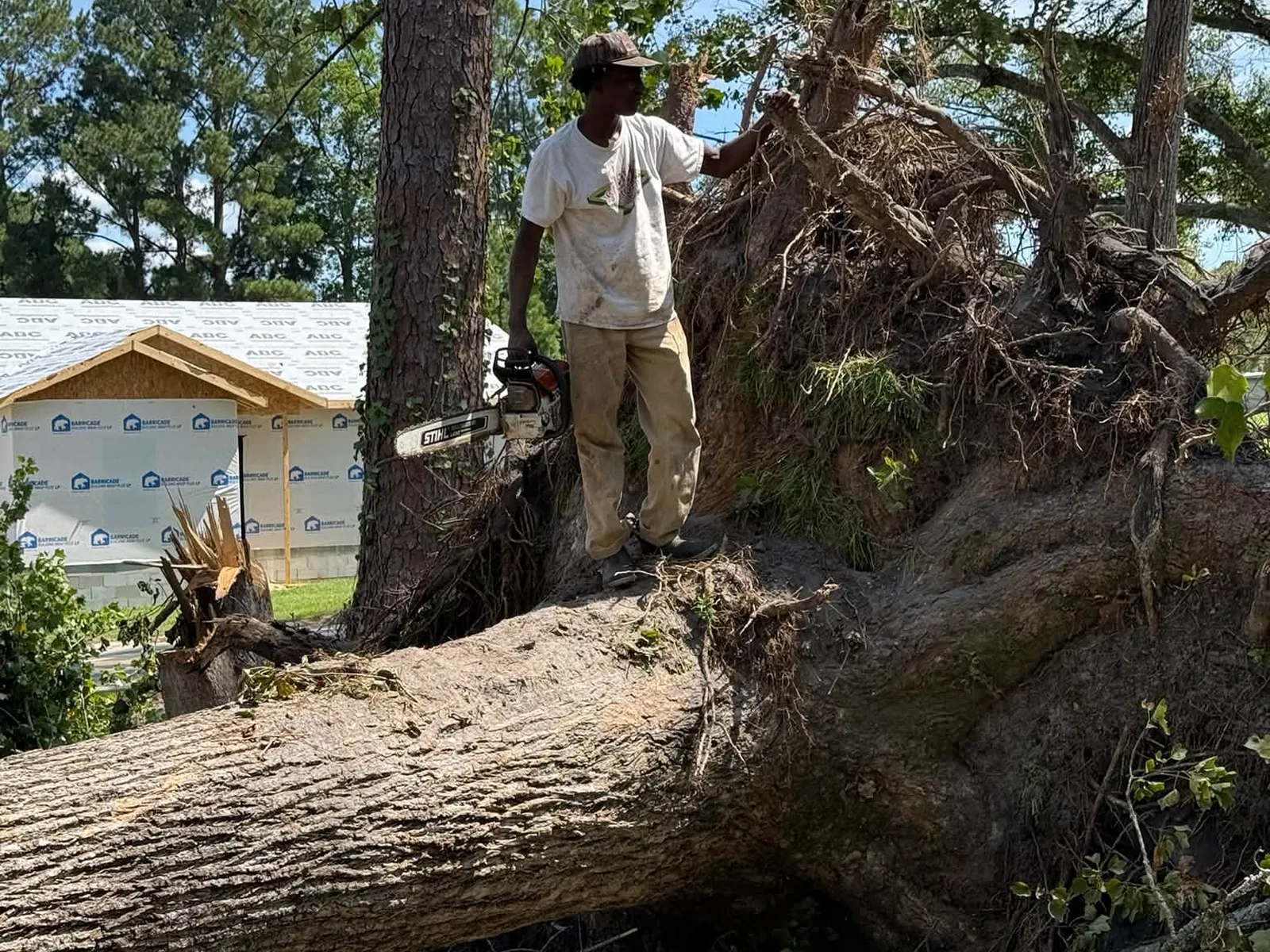
Do you need a permit to clear land in Georgia?
Usually no, if the job is under one acre and away from water. Once you disturb one acre or more, you need a land disturbance permit plus a state stormwater notice. Burning the debris is a separate permit. Ground near a creek changes the answer fast.
When can you clear land in Georgia without a permit?
Most small jobs are exempt. Georgia law skips any project that disturbs less than one acre. That covers a good share of the lot and acreage clearing done around Statesboro. Two things cancel that exemption.
The first is water. Land disturbing work within 200 feet of the bank of state waters loses the exemption, even on a quarter acre. The second is a bigger plan. A small pad inside a subdivision built to disturb five acres counts as part of the five.
Two more exemptions come up on rural tracts. Agricultural operations have their own carve out. So do forestry land management practices, including harvesting. There is a catch on that one. It applies when the forestry work disturbs a protected stream buffer. No other land disturbing activity is then allowed on the tract for three years. Clearing shooting lanes and food plots usually stays under an acre and stays exempt.
Here is how the common jobs line up.
| Job on the ground | Permit needed | Who issues it | Fee or notice | Source |
|---|---|---|---|---|
| Under one acre, away from state waters | No | Exempt by state law | None | O.C.G.A. 12-7-17 |
| Under one acre, within 200 feet of state waters | Yes | Your city or county | Local permit fee, set by that office | O.C.G.A. 12-7-17 |
| One acre or more | Yes, plus a state notice | City or county, plus Georgia EPD | $80 per disturbed acre to EPD, or $40 to EPD and $40 to the local office | Georgia EPD fee fact sheet |
| Burning land clearing debris | Yes | Georgia Forestry Commission | Good only for the day it is issued | Georgia Forestry Commission |
| Clearing a wetland or creek bottom | Yes | U.S. Army Corps of Engineers | Varies by permit type | USACE Savannah District |
What does a land disturbance permit involve at one acre or more?
At one acre or more, the paperwork starts. Georgia’s construction stormwater permit kicks in at that line. The first piece is an erosion, sedimentation and pollution control plan.
That plan cannot be sketched on a napkin. State rules require a design professional to prepare it. The permit defines that as someone holding a Georgia license in engineering, architecture, landscape architecture, forestry, geology or land surveying. A certified erosion and sediment control professional can also qualify.
The plan goes to the Georgia Soil and Water Conservation Commission for review. You also file a Notice of Intent with EPD at least fourteen days before work starts. State fees run $80 per disturbed acre where no local issuing authority is certified. Where one is certified, it splits into $40 per acre to EPD and $40 per acre to the local office. Local permit fees sit on top of that. Nearby Effingham County, home to Springfield, charges $40 per disturbed acre for its own permit.
Statesboro city limits or unincorporated Bulloch County?
Which office you call depends on the city line. Inside Statesboro city limits, the trigger is a residential or commercial development. Clearing, grading or stripping vegetation for one needs a Land Disturbing Activity Permit first. The city issues it under its soil erosion, sedimentation and pollution control ordinance. The Engineering Department takes those questions at (912) 764-0655. The city does not post an LDAP fee online, so call for the current amount.
Outside the city, Bulloch County is the local issuing authority for unincorporated land. Plans go to the state commission for review, then the county issues the permit. The county keeps certified erosion and sediment control inspectors on staff. Inspections are scheduled at (912) 489-1356. Both a county fee and a state fee are due before the permit is issued. The county posts its local fee as $100 plus $2 per acre in the development plus $40 per disturbed acre. Its page also says plans are required for projects over 1.1 acres. The state exemption ends at one acre, so treat one acre as the line and confirm with the county.
Can you clear land next to a creek or a pond?
Not right up to the bank. Georgia law sets a 25 foot buffer along the banks of all state waters. It is measured from the point where normal stream flow or wave action has worn the vegetation off the bank. No land disturbing activity is allowed inside that buffer unless the state grants a variance.
Wet ground is the second question. Along the Ogeechee and the Canoochee, creek bottoms and low hardwood flats can be jurisdictional wetlands. Building, excavating or placing fill in waters of the United States, wetlands included, takes a permit from the U.S. Army Corps of Engineers. The Savannah District covers this corner of Georgia. Digging a new pond runs into the same question. That is why the water on a tract gets checked before anything else.
Do you need a permit to burn the debris?
Yes, for land clearing debris. The Georgia Forestry Commission wants a call before you light it. Land clearing burns, farm and forestry material and storm debris all need notification or a permit. The number is 1-800-GA-TREES. Permits are good only for the day they are issued, so the call happens the morning of the burn.
Hand piled material is treated differently. Leaves and limbs stacked by hand no longer need a permit. Machine piled debris still does. The state treats machine clearing of an area as a land type change. That puts it under EPD land clearing burn rules and can require an air curtain destructor, depending on the county. Georgia also bans open burning from May 1 to September 30 in 54 counties. Bulloch is not on that list. Dry spells and local ordinances still shut burning down, so the Forestry Commission gets the first call.
What happens if you clear without a permit?
The state can stop the job and fine you daily. Georgia law sets a civil penalty of up to $2,500.00 per day. That covers violations of the erosion and sedimentation chapter or a permit condition. Each day the violation continues counts as its own violation. Municipal and magistrate courts can impose up to $2,500.00 for each violation brought under a local ordinance.
The fine is only part of the cost. A stop work order freezes a site with the ground already open and nothing stabilized. You still have to hire a design professional, produce the plan and pay the fees. Any sediment that left the property has to be cleaned up too. Answering the permit question first costs less than answering it after a complaint.
How the permit question gets answered before we start
Every job starts with a free estimate at the property. Acreage and water are the first two things we look at. We measure how much ground the work will actually disturb. We also find the creeks, ditches and wet bottoms near it.
If the job crosses a line, you hear about it before a machine rolls. The permit belongs to the landowner, so we tell you which office to call and what they will ask for. Forestry mulching often keeps a job simpler. The material stays on the ground as cover instead of being piled and burned. The permit stays in the landowner’s name, and the work waits until it is issued.
A free estimate at the property tells you whether a permit applies before the first pass. Ask for a free estimate and we will check the acreage and the water on your tract. Call or text (912) 712-6034.