
How much does tree removal cost in Georgia?
HomeGuide puts the national average for tree removal at $850. It lists a usual range of $400 to $1,200, with a floor of $200 and a ceiling of $3,000. Angi runs lower and averages professional tree removal at $750. Around Statesboro the tree is usually a tall pine, so height and access set the price.
What does tree removal cost by tree size?
Height is the first thing anyone asks about. Angi splits its published prices into tiers by how tall the tree stands. A 30 foot tree and an 80 foot pine are two different jobs for the same saw.
| Job | Published range | Source |
|---|---|---|
| Tree up to 30 feet tall | $150 to $450 | Angi |
| Tree 30 to 60 feet tall | $450 to $1,200 | Angi |
| Tree 60 to 80 feet tall | $800 to $1,500 | Angi |
| Tree over 80 feet tall | $1,000 to $2,000 | Angi |
| One medium pine, about 50 feet | $250 to $1,500 | Angi |
| Fallen or uprooted tree | As little as $300 to $500 | Angi |
| Stump removal, per stump | $100 to $500 and up | HomeGuide |
| Crane added to a removal | About $500 | Angi |
| Large tree near power lines | Upward of $10,000 | Angi |
Those numbers come from national cost guides. We price a tree after looking at it in person, so read the table as a starting point. Two pines of the same height on the same street can price differently.
What drives the price around Statesboro?
Pines here grow tall and stand close to houses. Loblolly and slash pine are the common ones, and plenty of them clear 60 feet. Height by itself moves a tree into a higher published tier.
Room for a machine is the other big one. Angi says a tight, hard to reach or unsafe spot adds 25% to 50% to the price. A pine standing alone in a field is the cheapest version of the job. The machine needs a path in and firm ground to sit on.
Distance to the house is the next question. A pine leaning over a roofline leaves a small window to drop it in. HomeGuide says trees near structures, power lines or property lines need more careful dismantling, which costs more. Tight targets come down in sections, and sections take time.
Ground and season matter too. Sandy soil around Statesboro goes soft after a long rain, and a heavy machine waits or works off firmer ground. Angi says emergency work comes at a premium when demand runs high after a storm.
How does an excavator change the job?
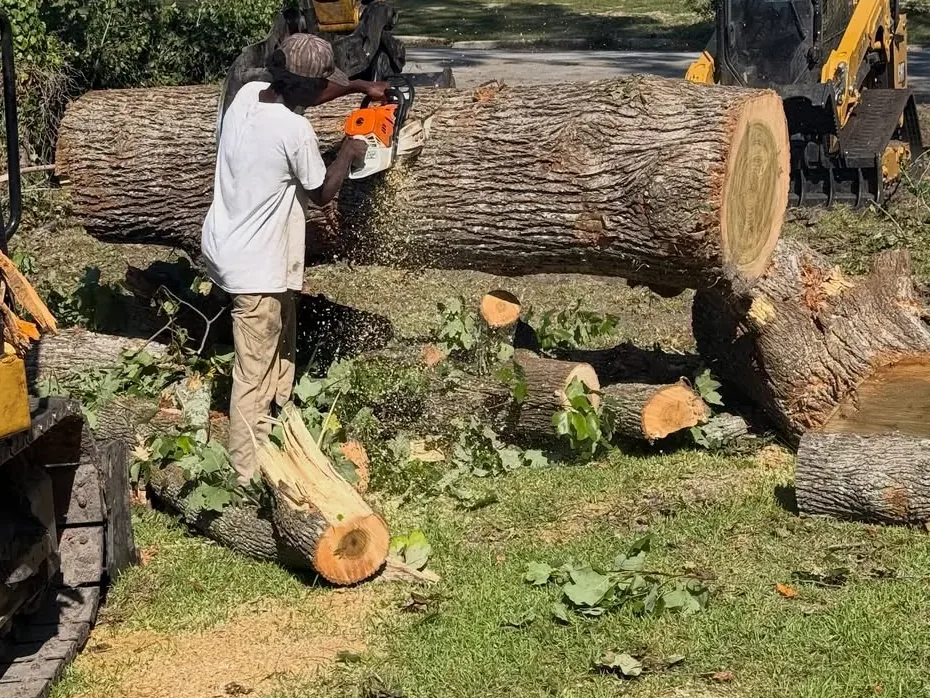
Our method is chainsaw felling backed by a CAT 308 excavator. The sawyer makes the notch and the back cut, and the machine pushes the trunk where we want it. On a dead pine the excavator can push it over before anyone stands under it. Then it lifts the cut sections into the dump trailer.
Weight is what the machine buys you. The excavator holds and lifts what a person cannot, so the trunk moves in fewer and bigger pieces. Fewer pieces means fewer cuts and less time on the job. It also keeps people out from under the tree.
The stump can come out on the same trip. The excavator digs the root ball and takes the tree out whole instead of leaving roots in the ground. Wood and brush leave on the dump trailer when we pull off the job. That is how dead and leaning pines come down on our jobs.
Some trees are not our work. A pine packed between a house and a fence leaves no room for the machine. Anything that needs climbing or a crane goes to a company set up for that.
Angi puts a crane at about $500 on top of the removal. Trees over 80 feet usually need one. Angi also says large trees near power lines can run upward of $10,000. If your tree is in that group, you hear it at the estimate rather than after.
What does stump removal add?
HomeGuide puts stump removal at $100 to $500 and up per stump. That sits on top of the price of the tree. We dig stumps out with the excavator rather than grinding them, so the roots leave with the stump.
Grinding chips the stump below grade and leaves the root system in the ground. Digging pulls the root ball out and leaves a hole to fill and level. Which one fits depends on what goes in that spot next. Our guide on grinding compared with digging a stump out lays out both.
Digging also means contacting Georgia 811 before the bucket goes in the ground. That happens on every job where a stump comes out. Ask for stumps dug out with the excavator while we quote the tree. Both come out on one visit.
What does a fallen tree cost?
A tree already on the ground is usually the cheapest one on the list. Angi says uprooted or fallen trees can cost as little as $300 to $500 to cut up and haul. HomeGuide says a cleanly fallen tree in an open area costs less than a standing tree. The hard part is done.
Timing can undo that saving. Angi says emergency removal comes at a premium, especially when demand runs high after a storm. Hurricane Helene came through in September 2024 and put trees down across this area.
A leaning tree with the root plate half out of the ground is its own case. It holds tension until it gets cut. The machine takes the weight first, then the saw goes to work.
Storm work has its own steps. The excavator lifts a trunk off a fence or a shed and sets it down clear. Then it digs the root plate out and fills the hole back in. That side of it runs under our fallen tree and debris work.
When do several trees become land clearing?
Pricing tree by tree stops making sense past a certain count. Ten pines on a half acre, priced one at a time, will read high. At that point the work gets measured by the acre instead.
Brush is the other half of that job. Tops and limbs off ten pines make a pile no trailer wants. A mulcher can grind that material into the ground instead of hauling it away.
A machine day covers more ground than ten separate takedowns. If you want a lot or a pasture opened up, ask about clearing measured by the acre. The estimate tells you which way your job prices out.
Can you burn the wood?
Not without a call first. The Georgia Forestry Commission requires notification or a permit before you burn land clearing debris or storm debris. The number is 1-800-GA-TREES.
Hauling is the other way out. Logs and brush go on the dump trailer and leave with us when the job is done. Our guide on what Georgia requires before you burn has the rest of those rules.
How do you get a number on your tree?
Every estimate starts with a look at the tree in person. Photos leave out the slope and the space around the trunk. We come out, size up what the excavator can reach and tell you what the job takes. Estimates are free.
A quote covers what leaves the property too. Cutting a tree down and hauling the wood off are two different amounts of work. Tell us if you want the trunk cut into lengths and stacked on site.
Call or text (912) 712-6034 and we will set a time. You can also send us the details on your tree and we will get back to you. It helps to know how many trees, roughly how tall, and how close they stand to the house. See what our tree removal covers for how the work runs from the estimate to the cleanup.