
How much does it cost to dig a pond in Georgia?
HomeGuide puts the cost to build a pond at $2,900 to $15,600 on average. Per square foot, HomeGuide says $2.50 to $9.00. For ponds under 10 acres, it lists $3,000 to $15,000 per acre. Around Statesboro, the clay and the water table under your site decide where a dug pond lands.
This guide covers pond digging cost for dug ponds, the kind excavated below grade. A pond that needs an engineered dam is a different project, and it starts with an engineer.
What does a pond cost by size?
HomeGuide sorts its pond prices by surface area and by pond type. Every row below comes from HomeGuide. The lower rows price the job in other units, plus two costs that come before any digging.
| Pond or line item | Published range | Source |
|---|---|---|
| Half acre pond | $2,400 to $11,600 | HomeGuide |
| 1 acre pond | $3,000 to $15,000 | HomeGuide |
| 2 acre pond | $6,000 to $30,000 | HomeGuide |
| Farm pond, on average | $3,000 to $23,000 | HomeGuide |
| Fishing pond | $7,000 to $59,000 | HomeGuide |
| Ponds under 10 acres, per acre | $3,000 to $15,000 | HomeGuide |
| Pond building, per square foot | $2.50 to $9.00 | HomeGuide |
| Digging a large pond, per cubic yard | $1.50 to $4.00 | HomeGuide |
| Geotechnical soil report | $1,000 to $5,000 | HomeGuide |
| Site visit, where a contractor charges one | $80 to $450 | HomeGuide |
Those are national guide figures. We price each pond after looking at the site in person, so read the table as a starting point. How the dig itself runs is on our page for pond excavation around Statesboro.
Why do the published ranges run so wide?
HomeGuide prices ponds three ways: per acre, per square foot and per cubic yard. The first two measure the surface of the water. The cubic yard price measures the dirt that comes out of the hole. Two ponds with the same surface can move very different amounts of dirt.
Depth makes that difference. HomeGuide says fishing ponds are 6 to 8 feet deep on average. A deeper basin at the same size means more cubic yards to dig and more spoil to place.
The lay of the land moves the number too. HomeGuide says sloped sites require more labor and excavation. It also says most larger ponds have no liner or a natural clay liner. So the ground itself has to hold the water, and around Statesboro that means finding the clay.
Does the pond site need clearing first?
Most pond sites here have something growing on them. Planted loblolly and slash pine cover a lot of this ground, with sweetgum and yaupon under them. Trees and stumps come off before the dig starts, and that clearing moves the number.
The excavator pulls each stump out whole, roots and all. UGA Extension lists water piping through root holes among the common causes of pond seepage. A root left to rot in a pond bank can open that kind of path.
Wooded sites start with clearing trees off the pond site. Our guide to what land clearing costs per acre covers that part of the bill.
Will the ground hold water?
Around Statesboro the ground is mostly sandy loam and loamy sand over clay. HomeGuide says rocky or sandy soils are not ideal for ponds. UGA Extension says soils for pond construction should contain at least 25 percent clay. The sand on top drains, and the clay underneath is what holds.
A dug pond holds water in one of two ways. Its bottom reaches clay tight enough to seal, or it sits below the water table. UGA Extension describes excavated ponds as dug below the water table and filled by seeping ground water. The water level in that kind of pond follows the ground water at that spot.
Before the real dig, we dig a test hole. It tells you how much sand sits over the clay and how high the water stands. A bottom left sitting in clean sand leaks. UGA says to check pond bottoms for sand, gravel or rock and to consider clay liners.
HomeGuide puts a geotechnical soil report at $1,000 to $5,000 on average. A deep sand site can still hold water with a packed clay liner. The test hole shows whether yours needs one, before you commit to the pond.
How deep should the pond be?
UGA Extension sets pond depth with drought in mind. It says to allow at least 2 feet of water loss from evaporation and seepage. It adds a 3 foot minimum left in the drought, for at least 5 feet over most of the pond.
UGA also says properly built ponds have little, if any, area less than 3 feet deep. Shallow edges grow weeds, so we cut the banks steep enough to drop off quickly. Every extra foot of depth is more dirt to dig and more spoil to place.
Water table ponds carry a catch. UGA says many of them lose most or all of their water during a drought. It also says there is a practical limit to deepening a dug pond. Ponds dug very deep can be hard to reach from shore because of steep banks.
A pond that fills from runoff needs enough land draining into it. UGA Extension says Georgia ponds generally need 10 acres of watershed for each acre of pond. It says 20 acres would improve the water supply during droughts. What the test hole finds about the clay and the water sets the depth plan.
Where does the dirt from the pond go?
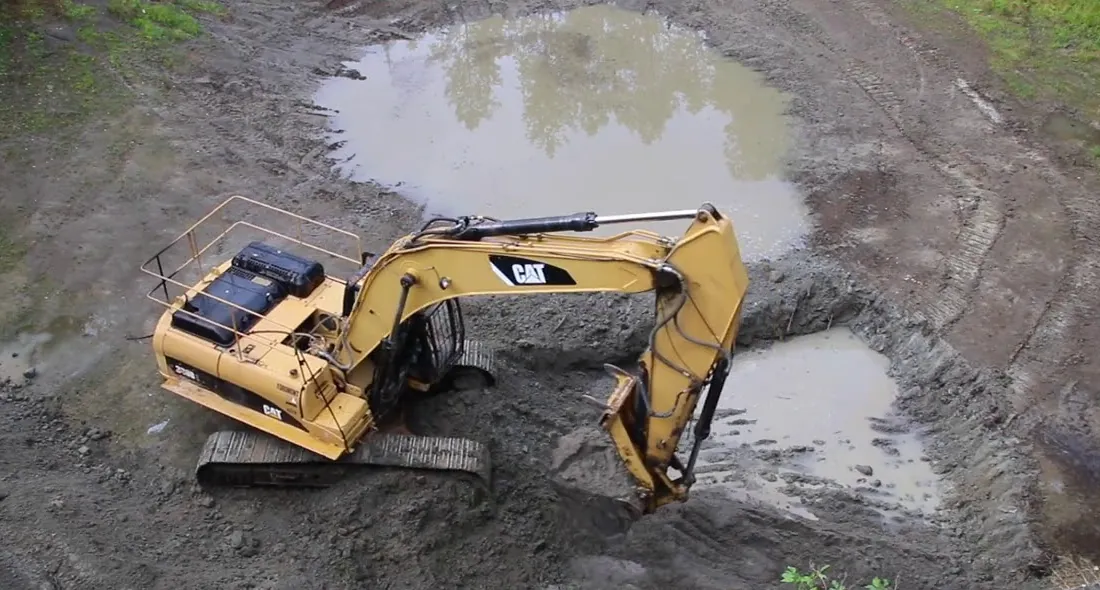
Every cubic yard that comes out of the hole needs a place to go. The CAT 308 excavator digs the basin and cuts the banks. The CAT 275 track loader moves the spoil, spreading it out or building a berm. Hauling it off in the dump trailer is the other option.
Spreading keeps the dirt on your land, as grading and leveling the spoil across a field or a low spot. A low berm on the downhill side raises the water level. Under Georgia’s Safe Dams Act, a barrier six feet high or less is not a dam.
Hauling off means loads on the dump trailer, and every load is a trip. Spoil can also raise a house pad or fill a low spot on the same trip. That side of the job runs as dirt work like house pads.
Do you need a permit to dig a pond in Georgia?
A small pond dug below grade stays clear of the dam rules. Under Georgia’s Safe Dams Act, a dam stands at least 25 feet tall or stores at least 100 acre feet. EPD requires a permit only when that dam also meets the Category I criteria. Category I means a failure would probably cost lives.
Georgia’s erosion law draws the next line at one acre. Georgia Code section 12-7-17 exempts projects with less than one acre of disturbed area. That exemption does not apply within 200 feet of the bank of any state waters. Channels that carry water only during and just after rain do not count as state waters for that rule.
The line is one acre of disturbed ground, and clearing and spreading spoil disturb ground too. The same law lists farm ponds among the agricultural operations it exempts. Georgia also sets a 25 foot buffer along the banks of all state waters. Our guide to Georgia land disturbance permits covers the offices and the fees.
The Corps is the last question. The Savannah District says building, excavating or placing fill in waters of the United States takes a Corps permit first. Wetlands count as those waters.
Federal rules at 33 CFR 323.4 exempt building farm or stock ponds from that permit. The exemption drops away when the work converts part of a stream or wetland to a new use. The test is whether flow could be impaired or the reach of the water reduced. The Savannah District says to coordinate stock ponds with your local Natural Resources Conservation office or the Corps before construction.
That is why we build ponds on high ground or in dry depressions. You hear at the estimate if your spot touches any of these lines.
What falls outside a dug pond job?
Our part of a pond is the dig and the dirt work around it. A pond that needs an engineered dam or spillway starts with an engineer, and we say so at the estimate. Synthetic liners go to an installer set up for them.
Fish stocking comes after the pond fills, and it is not our work. Pumps and fountains are not part of the job either. Trenches, footings and other digs fall under our excavation work around Statesboro.
How do you get a number on your pond?
Every estimate starts with a look at the site. We check the soil and where the water sits after a rain. If the soil question is open, we dig a test hole. The estimate is free.
Call or text (912) 712-6034 to set a time. You can also send us the details on your pond site. It helps to know the size you want and what the pond is for.
We work out of Statesboro and cover about 50 miles around it, including Metter, Claxton, Sylvania, Swainsboro and Pembroke. See pond digging for farms and backyards for how the work runs from the test hole to the finished banks.